Robotics / Mechatronics / 3D Printing / Animation Control
Bonnie Animatronic
2024 • Functional Prototype
This was my breakout engineering project: a self-built animatronic Bonnie head inspired by Five Nights at Freddy’s. I started with no real robotics, electronics, 3D printing, or animation software experience, so I forced myself to learn through trial and error to make Bonnie actually move in real life.
Status
Functional Prototype
Motors
11 Servo Motors
Role
Full Build
Cost
~$180 Total
Demo / Media
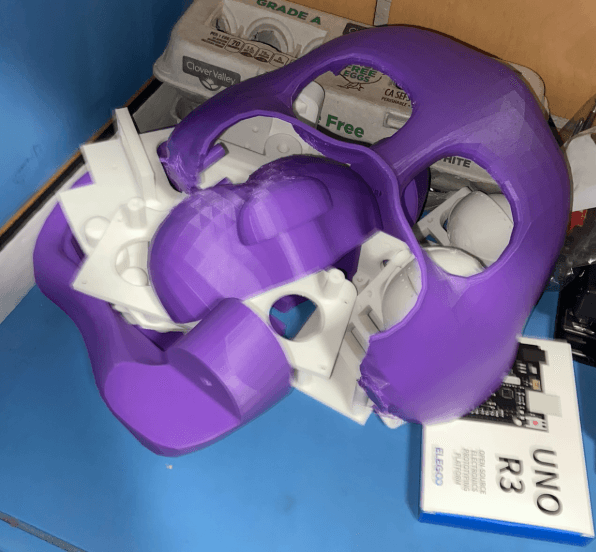
The media shows the project at different stages: printed parts, internal wiring, Bottango animation control, and the final animatronic face coming together.
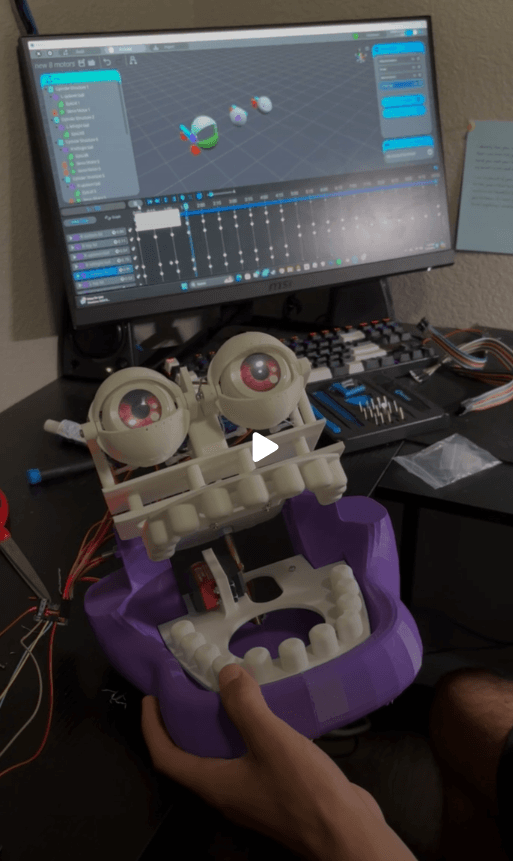
Bottango Animation Control
The project went beyond simple motor testing. I used Bottango to map digital animation timelines to real physical servo movement.
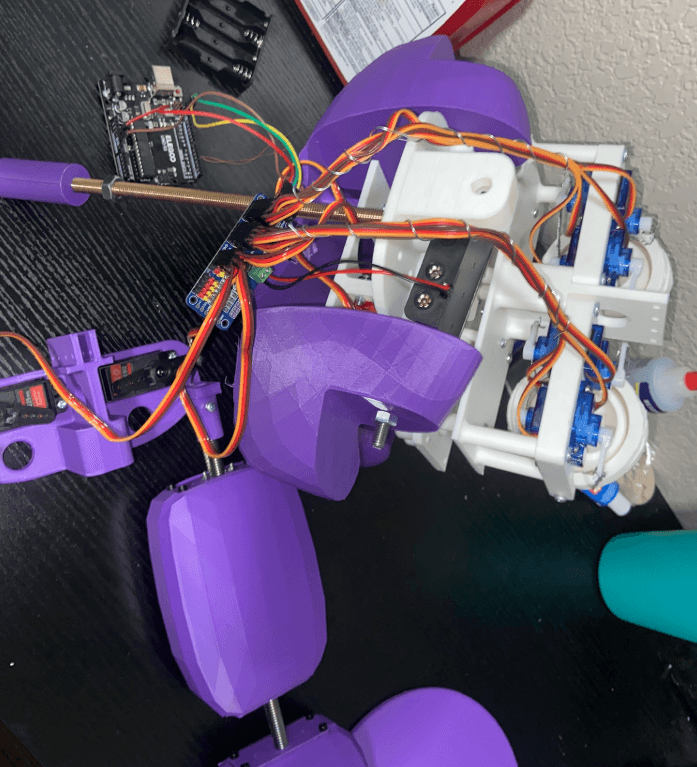
Internal Servo + Wiring Layout
Inside the head, the motion depended on a dense layout of servos, wiring, rods, linkages, and mechanical mounts.
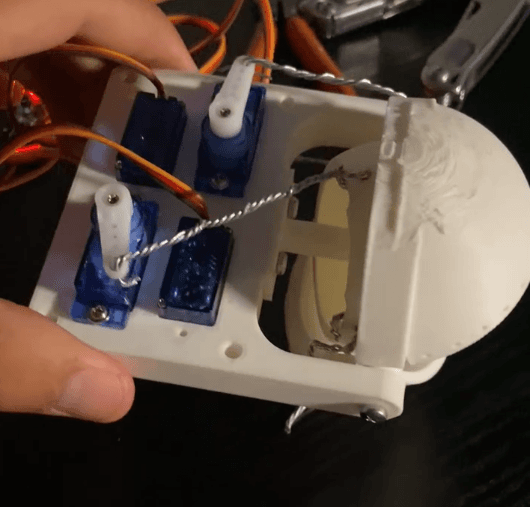
Eye Mechanism Debugging
The eye mechanism was one of the hardest systems because the wire-driven design added torque and strain to the small servos.
Mechanical Build
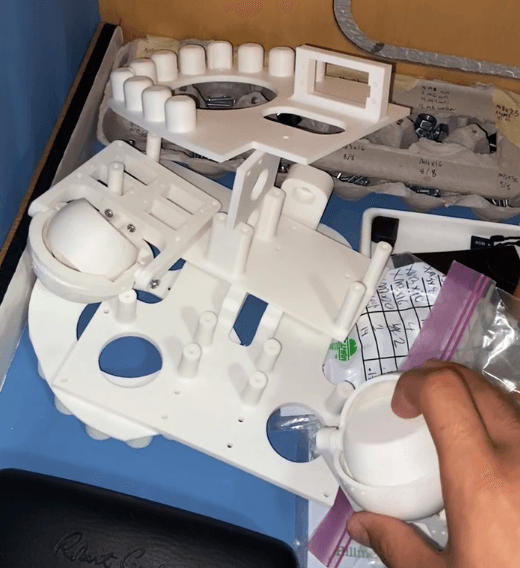
The mechanical side was a mix of 3D-printed parts, fasteners, rods, springs, linkages, and servo mounts. I used online model files as a starting point for the prints, but the actual build still required a lot of physical problem solving: fitting parts together, mounting motors, dealing with tolerances, and figuring out how motion would transfer through the head.
Electronics + Animation
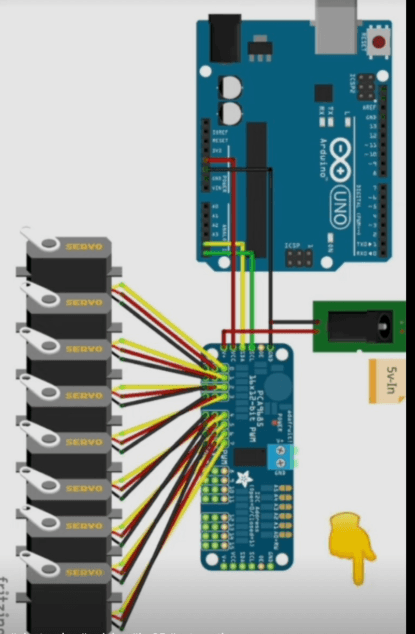
The project did not come with electronics instructions so I had to learn from scratch. The electronics were built around an Arduino board initially until I realized an ESP32 is far superior to use. I also used a servo driver, and 11 servo motors. Once the motors could move individually, I connected the project to Bottango, an open source animation software for hardware, so the animatronic could move through an animation timeline instead of just running basic test commands. That was the moment it started feeling less like messing around with a 3D printer and more like a real project with a foreseeable outcome.
Technical Highlights
Built a physical Bonnie animatronic head using 3D-printed parts and online model files as the foundation.
Integrated 11 servo motors with Arduino code and a servo driver to control eyes, eyelids, ears, and facial motion.
Used Bottango animation software to coordinate real motor movement with digital animation timing.
Worked through mechanical linkages, springs, rods, collars, fasteners, servo mounts, and tolerance issues.
Debugged motor burnout, wiring problems, mechanical looseness, limited eye mobility, and high torque on small servos.
Tools / Hardware / Software
Approximate project cost: around $183 total.
Mission Log
This was my breakout engineering project. I originally decided to build Bonnie’s head because I was a huge fan of Five Nights at Freddy’s when I was 10. I was fascinated by the idea of these robots that looked so cool and lifelike in the game, but did not actually exist in real life. Ever since then, I held onto the idea that maybe one day I could build something like that myself. When I went back home for the summer as a first-year Berkeley student, I had not yet learned any electronics or real engineering, but I decided to take on the challenge of recreating Bonnie’s head and making it move the way it did in the video game. This project is special to me because, as a child, the animatronics from the game sparked my curiosity and helped motivate me toward engineering. In many ways, this project was a love letter to my younger self, proving that I could bring an idea to life. It showed me that with enough effort and diligence, I could create and build things from scratch. I did not start with experience, but I knew the only way to learn was by doing, so I took something that inspired me and turned it into something real.
The project forced me to learn everything from scratch. I had to buy a 3D printer and figure out how to 3D print parts, assemble mechanical linkages, learn how to wire things into a microcontroller, impliment 11 motors into a servo driver, upload Arduino code, and control real hardware. After that, I learned Bottango, an open-source animation software, so I could assign digital animations to real physical motors through adding 3D sprites, fixing joints, and adding digital motors which controlled the ones in real life. That turned the project from a difficult 3D printing project into something that could move with life through timing and personality.
The hardest part was making all of the physical systems cooperate. I burned out 3 motors, fought tolerance issues, and struggled with mechanisms that needed to be rigid enough to hold position while still moving smoothly. The eye mechanism was especially difficult because the wire-driven design placed too much torque on the small servos and limited the range of motion. It worked well enough to prove the concept, but it also showed me exactly what I would redesign in a future version.
By the end, the project worked. I was able to create fluid real-life movement and prove that the animatronic head was possible and functional. More importantly, the project changed the way I saw engineering. It taught me that engineering is not just about already knowing what to do. It is about being willing to learn, fail, burn motors, fix mistakes, and keep building until it works, then you make it better.
Final Result
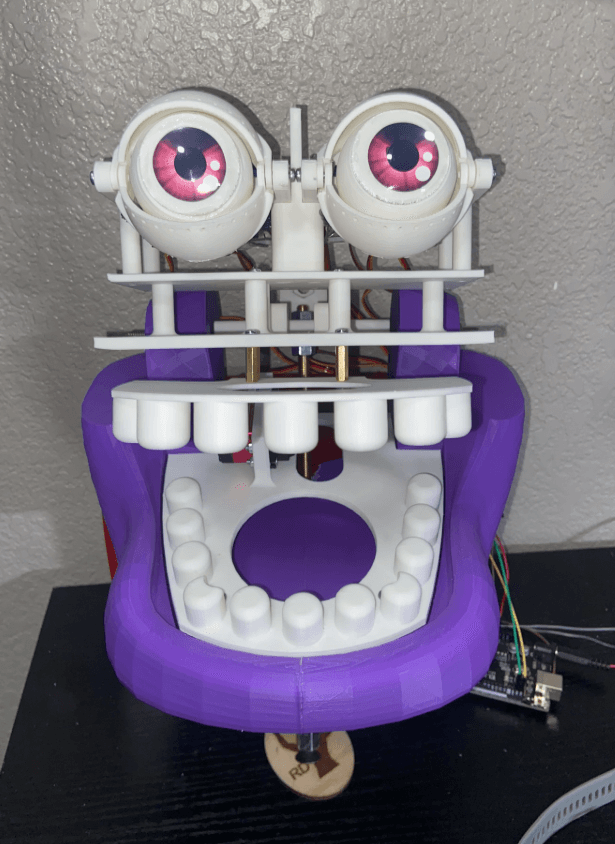
The final prototype achieved coordinated physical motion using 11 motors, an ESP32, a servo driver, and Bottango animation. It was not perfect, but it was real, functional, and finished. For me, this project proved that I could take an idea way outside my comfort zone and force it into reality through iteration and grit.
What I’d Improve
I would redesign the eye mechanism to reduce wire tension and torque on the small servos. A future version would use cleaner linkages, smoother motion, less motor strain, and a better range of movement. I would also organize the wiring more cleanly and design the internal structure with maintenance access in mind from the beginning.